Peltier-Powered Surgical Cold Table
Summary
I was initially inquired to build this project in October/November 2025 and completed the build in January 2026. This medical cart features a solid Teflon top, four 24V Peltier cooling modules, dual water cooling loops, and a 1500W power supply tuned for 24V operation. The final assembly is built on an aluminum medical cart and was delivered to a clinic to support hair transplant surgery by keeping follicle tissue cool on an interposer.
Purpose and Application
The surgical cold table is designed to maintain a sterile, low-temperature work surface for hair follicle preparation during transplant procedures. The goals were:
- Maintain a stable cold interface around -1°C under a medical interposer.
- Provide a non-porous, easy-to-clean top surface.
- Keep the thermal load off the cart by using water-cooled heat rejection.
- Preserve portability and maneuverability inside a clinical workspace.
The Teflon top provides chemical resistance and a smooth sterilizable surface, while the dual radiator loops and active fans allow the Peltier modules to run for extended periods without overheating.
Design Requirements
- Cold surface target: about -1°C at the tissue contact area
- Sterilizable top material compatible with medical cleaning agents
- Minimal vibration and spill risk
- Portable electrical supply with enough margin for sustained cooling
- Redundant cooling capacity in case one water loop needs maintenance
System Overview
The system is divided into three functional subsystems:
- Thermal interface: 3/4” Teflon plate with a reinforced acrylic backing, providing a smooth sterile surface.
- Cold-side cooling: four Peltier modules mounted between the Teflon top and copper cold plates.
- Heat rejection: dual water loops with 360mm radiators, pump/reservoir units, and six 120mm fans.
Power is supplied from a 1500W 30V PSU configured to 24V, giving enough current headroom while keeping the Peltier modules within their nominal operating range. The chassis is grounded through a dedicated copper lug to ensure user safety.
Specifications
| Parameter | Value |
|---|---|
| Surface Temp | -1°C |
| Power supply | 24V |
| Max power | 1500W |
| Fans | 6 × 120mm |
| Peltier modules | 4 × 24V pcs |
| Top material | PTFE |
| Main frame | Aluminum Cart |
Materials
- Aluminum medical cart
- 1500W 30V PSU, configured to 24V
- 3/4” Teflon sheet
- 1/8” clear acrylic sheet
- 6× 24V 120mm fans
- 2× 360mm water cooling radiators
- 2× water cooling pump/reservoir AIOs
- 8× G1/4” compression fittings
- 6× G1/4” 90° fitting adapters
- 4× 24V Peltier modules
- 2× copper water cooling blocks
- 4× 1/4” hose clamps
- 3× copper lug crimps (one for chassis ground)
- 4× ferrule crimps
- ~20× adjustable cable ties
- 14AWG cable
- Distilled water with biocide
- Wall outlet cable with built-in switch capable of 120VAC@15A
- 60mm Noctua fans (optional, for replacing PSU fans for quieter operation)
Materials Discussion
Chassis and Top Plate
A single sheet of Teflon was selected for the top surface because it is smooth, chemically inert, and easy to sterilize. The inert surface also avoids absorbing cleaning agents, which is important in a surgical environment. The sheet was mounted on the cart so the underside could house the thermal stack without introducing mechanical stress on the top surface.
Thermal Stack
Four Peltier modules were selected because they provide a compact way to move heat from the cold side to the hot side without requiring a compressor or refrigerant circuit. The modules are electrically driven and allow the surface to reach sub-ambient temperatures in a confined payload area.
Copper cold plates were used on the hot side to spread heat into the water cooling blocks. Thermal interface material was applied at each junction to minimize thermal resistance and improve stability.
Water Cooling
Water cooling was chosen to move heat away from the Peltier hot side efficiently and keep the cart quiet enough for clinical spaces. Two separate loops were installed so the system remains operational even if one loop needs servicing, and so the load is distributed across more radiator area.
Each loop uses a 360mm radiator, an AIO pump/reservoir, and a set of 120mm fans. The hose routing was kept tight and secured with clamps to avoid kinks and reduce the chance of a leak.
Electrical Components
The 1500W PSU was derated to 24V to match the Peltier modules while preserving available current. A single ground point on the chassis ensures electrical safety, and the wiring uses 14AWG cable with ferrules for robust terminations.
Auxiliary fans support the radiators and help keep the water temperature in the safe operating range. The cart also includes a long power cable so it can reach outlets in a clinical workspace without repositioning the entire table.
Build Process
1. Cart Preparation
- Added an acrylic backing plate to reinforce the Teflon and create a component mounting backplane.
2. Mounting the Cooling Stack
- Placed the Peltier modules between the Teflon top and copper water cooling blocks using thermal paste for increased heat transfer.
- Secured the modules with a lightweight compression frame cut out of Teflon and mounted underneath the top surface to maintain even pressure.

3. Installing the Water Loops
- Mounted the two radiators on the acrylic backplane of the cart.
- Installed the pump/reservoir units on the acrylic backplane
- Routed hoses using G1/4” fittings and 90° adapters, then clamped each connection to the water blocks.

4. Electrical Wiring
- Wired the PSU output to the Peltier modules and fans.
- Added a chassis ground using a copper lug crimp.
- Bundled cables neatly and secured them with adjustable cable ties.


5. Leak Testing and Filling
- Filled each loop with distilled water and biocide.
- Pressurized the loops briefly while inspecting every fitting.
6. Initial Testing
- Powered the cart and monitored the cold plate temperature with an IR temperature gun.
- Verified that the water loops and radiators stayed within the acceptable temperature range.
- Confirmed that the heat rejection side never exceeded safe operating limits for the Peltier modules.
- The cart was initially very loud due to all the fans. This noise was later reduced by replacing the 60mm fans inside the PSU with Noctua 60mm fans.
Final Product

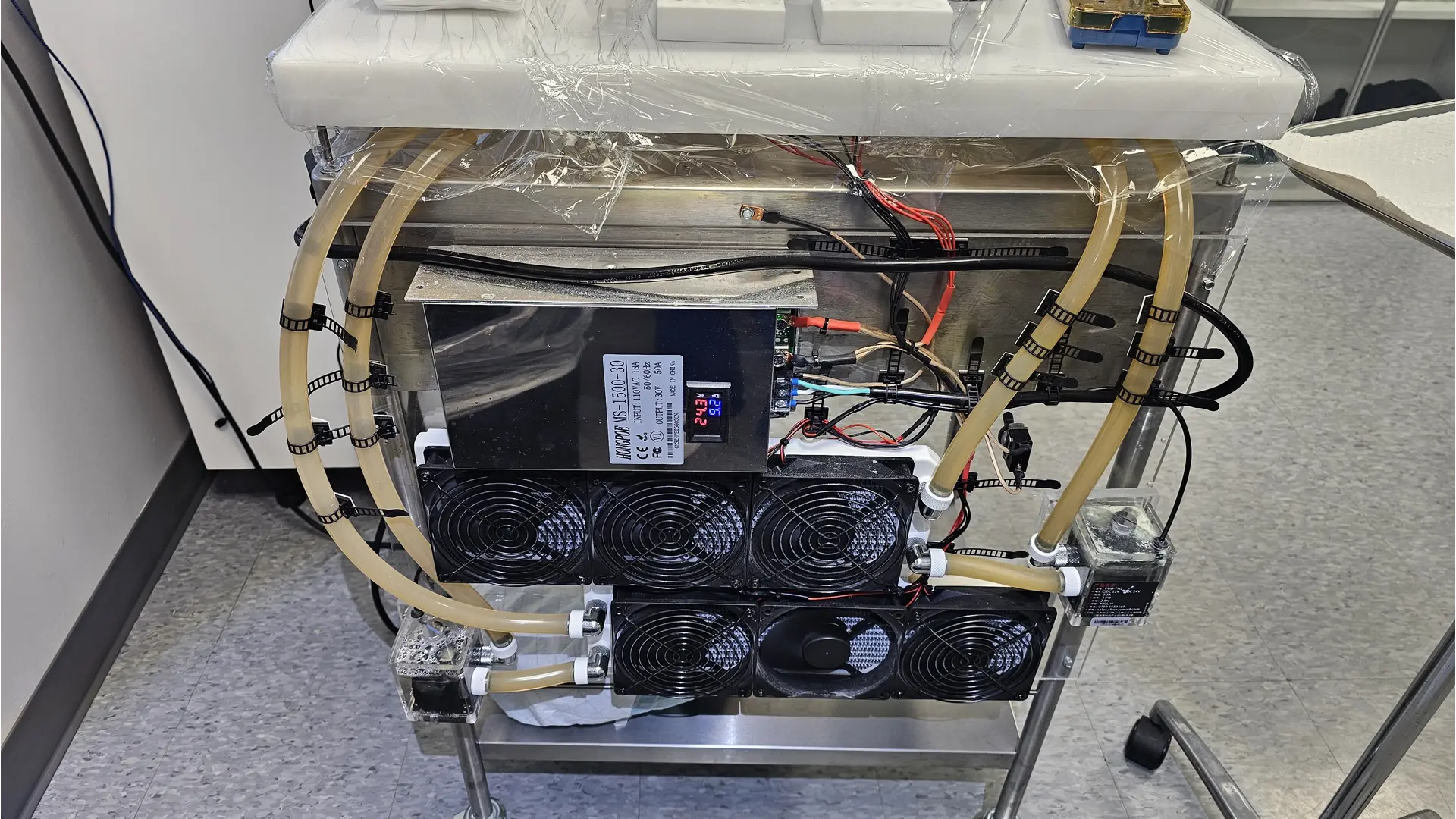
The completed cart presents a clean top surface with all cooling hardware contained beneath the working plane. The water loops and radiator fans are easy to service, and the cart remains mobile thanks to the medical-grade casters.
Results
The completed system met the project goals:
- The cold surface was capable of stabilizing around -1°C with the Peltier stack running at 24V.
- The water cooling loops allowed sustained operation for the duration of a surgical procedure.
- The Teflon top remained easy to clean and left minimal residue after disinfection.
- Wires, Tubing, and Components were nice and tidy all contained in the back of the chassis.
During trial runs, the hot-side water temperature stayed in the safe range, and the radiators were able to reject sufficient heat without fan noise becoming intrusive in a clinical environment.
Field Use
In the clinic, the cart was deployed for hair transplant surgery extraction. The long power cable and lightweight cart design made it easy for staff to position the unit near the surgical table. The Teflon top surface provided a good interface for an interposer and reduced the need for frequent repositioning.
A few practical observations:
- The smooth Teflon top is easier to wipe down than other plastics or painted surfaces.
- The dual-loop cooling design allowed for continuous operation.
- Temperature range was satisfactory for preserving hair follicle extractions.
Product Gallery


Conclusion
This surgical cold table turned a medical cart into a portable, low-temperature workspace that supports transplant procedure needs. The key design wins were the sterilizable Teflon surface, water-cooled heat rejection, and an electrical assembly with proper grounding, and the client was happy with the result.
Future iterations could add a dedicated temperature controller and a more compact pump layout, but the current build already delivers the required cooling performance and field usability. I would also consider switching the clear tubing to dark opaque tubing, since clear plastics tend to yellow over time even when the coolant remains clean. Replacing the six 120mm radiator fans with quieter Noctua fans would reduce noise, and using an alternate radiator cooling approach or adding filters would further improve operating room suitability by reducing or eliminating dust kick up.